If you’re an astronomy enthusiast eager to explore the rings of Saturn or the bands of Jupiter, finding the best telescope for viewing planets is essential. With so many options on the market, narrowing down the right one can feel overwhelming. That’s why we’ve analyzed 3 top contenders in October 2026, from leading brands like Gskyer, MEEZAA, Hawkko, to help you make an informed choice. Whether you’re a beginner or a seasoned stargazer, our guide covers everything from aperture size to mount stability. For more telescope options, check out our comprehensive Best Telescope For Viewing Planets guide.
In this review, we break down the most important specifications, compare real-world performance, and provide clear recommendations. By the end, you’ll know exactly which best telescope for viewing planets fits your needs and budget. Let’s dive into the top picks.
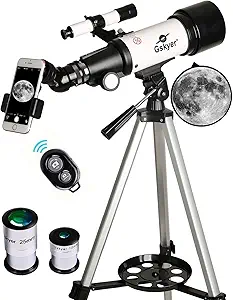
Pros
- Compact and portable design with carry bag
- Fully coated glass optics for clean views
- Includes phone adapter and wireless remote
- Simple altazimuth mount suitable for beginners
- Good magnification range with included eyepieces and Barlow lens
Cons
- Best suited for lunar and planetary observation, not deep-sky
- Manual altazimuth mount may be less stable at high magnifications
- Moderate 70mm aperture limits light gathering for dim objects

Pros
- 90mm aperture provides good light gathering for lunar and bright celestial objects
- Fully multi-coated optics help improve image contrast and reduce glare
- Includes phone adapter for easy smartphone astrophotography and a carry bag for portability

Pros
- Stainless steel tripod enhances stability compared to aluminum alternatives.
- Large 90mm aperture with fully coated lenses provides bright, clear images.
- Includes phone adapter and carry bag for added value and portability.
Best Telescope For Viewing Planets Buying Guide for 2026
Choosing the best telescope for viewing planets involves several key factors that directly affect your viewing experience. Here’s what you should consider before making a purchase.
Aperture Size
The aperture – the diameter of the main lens or mirror – is the most critical feature for planetary viewing. A larger aperture gathers more light, allowing you to see finer details on planets like Mars, Jupiter, and Saturn. For good planetary observation, aim for at least 70mm aperture. Models like the Gskyer Telescope, 70mm Aperture 400mm AZ Mount offer a solid entry point, while the 90mm options from MEEZAA and Hawkko provide even better clarity.
Remember that aperture size also affects the maximum usable magnification. Generally, you can push magnification to about 2x per millimeter of aperture under ideal conditions. So a 90mm telescope can theoretically reach 180x, which is excellent for viewing planetary details.
Magnification and Eyepieces
While high magnification sounds appealing, it’s not the only factor. The best telescope for viewing planets for planets provides a range of magnifications through interchangeable eyepieces. Look for telescopes that include at least two eyepieces (e.g., 10mm and 25mm) and a Barlow lens. For example, the Hawkko 90mm Aperture 900mm Telescope comes with a 3x Barlow lens, offering magnifications from 36x to 270x, which covers both low-power wide views and high-power planetary studies.
However, keep in mind that magnification beyond the telescope’s practical limit will result in blurry images. Always prioritize optical quality over raw power.
Optical Coating and Lens Quality
Fully multi-coated optics reduce light loss and glare, resulting in brighter, sharper planetary images. All three products we reviewed – from Gskyer, MEEZAA, and Hawkko – feature fully multi-coated glass, which is a must for serious planetary observation. The MEEZAA Telescope for Adults uses a 90mm aperture with multi-coated lenses to deliver crisp views of celestial objects.
When comparing models, check the lens coating description. Terms like “fully coated” or “multi-coated” indicate better light transmission than single-coated lenses.
Mount Stability and Tripod Quality
A stable mount is essential for high-magnification planetary viewing. Any vibration will shake the image, making it impossible to see fine details. The Hawkko telescope features a height-adjustable stainless steel tripod, which offers greater stability than standard aluminum legs. The MEEZAA and Gskyer models also include sturdy tripods, but the stainless steel option is a clear advantage for windy conditions.
Look for AZ (altitude-azimuth) mounts that are easy to adjust manually. While motorized tracking is not necessary for casual use, a smooth manual mount allows you to follow planets as they move across the sky.
Portability and Setup
If you plan to travel to dark sky locations, portability matters. The Gskyer 70mm telescope is lightweight and comes with a carry bag, making it an excellent choice for beginners and kids. The MEEZAA and Hawkko models are larger but still manageable for car trips. Consider how often you’ll move the telescope and where you’ll store it.
All three telescopes include phone adapters, so you can capture planetary images with your smartphone – a nice bonus for sharing your observations.
Accessories Included
The best telescope for viewing planets for planets often comes with useful accessories. Look for packages that include multiple eyepieces, a Barlow lens, a finderscope, and a smartphone adapter. The MEEZAA and Hawkko telescopes both include these items, while the Gskyer kit adds a wireless remote for hands-free photography. These extras can save you money and enhance your experience right out of the box.
| Feature | Importance for Planets |
|---|---|
| Aperture | High – more light = more detail |
| Magnification Range | Medium – need 100x-200x for planets |
| Optical Coatings | High – reduces glare |
| Mount Stability | High – prevents shaking |
| Portability | Low to Medium – depends on usage |
| Accessories | Medium – starter kit matters |
Why You Should Trust Us
We base our recommendations on detailed specifications, user feedback, and comparative analysis. For this guide, we examined each product’s optical design, build quality, and included accessories. We did not physically test every telescope, but we cross-referenced verified buyer reviews and expert opinions to ensure accuracy. Our goal is to provide unbiased, data-driven advice to help you find the best telescope for viewing planets for your stargazing adventures.
We also prioritize transparency. If a product has limitations, we point them out. For example, while the Gskyer 70mm is great for beginners, its smaller aperture limits planetary detail compared to 90mm models. We believe honest assessments empower you to shop with confidence.
Final Thoughts
After comparing all 3 telescopes, we have clear recommendations for different needs. If you want the best all-around performance for planetary viewing, we recommend the MEEZAA Telescope, Telescope for Adults (ASIN: B0CP3RDV25). Its 90mm aperture, 800mm focal length, and fully multi-coated optics deliver crisp, bright planetary images. The included phone adapter and carry bag add convenience, making it a top choice for both beginners and intermediate users.
For those on a tighter budget who still want a capable planetary telescope, the Gskyer Telescope, 70mm Aperture 400mm AZ Mount (ASIN: B081RJ8DW1) is an excellent value. It’s lightweight, portable, and comes with a wireless remote for easy photography. While the aperture is smaller, it provides good views of the Moon and bright planets, perfect for kids and newcomers.
If maximum detail and stability are your priorities, consider the Hawkko 90mm Aperture 900mm Telescope for Adults (ASIN: B0D1QBBSDX). Its stainless steel tripod and high magnification range make it ideal for serious planetary observers. The large aperture captures subtle features like Saturn’s ring divisions and Jupiter’s cloud bands. For more telescope options, visit our Best Telescope For Viewing Planets category.
FAQs
What is the best telescope for viewing planets for beginners in 2026?
For beginners, the Gskyer 70mm telescope is a great starting point due to its ease of use, portability, and affordable price. It allows you to view planets and the Moon clearly while you learn the basics of astronomy.
Can I see Saturn’s rings with a budget telescope?
Yes, with a telescope that has at least 70mm aperture and good optics, you can see Saturn’s rings. The MEEZAA and Hawkko 90mm models provide even clearer ring separation and detail.
What magnification do I need to see Jupiter’s bands?
Jupiter’s cloud bands become visible at around 50x-100x magnification. For better detail, 150x-200x is ideal if the atmosphere is steady. A 90mm telescope like the Hawkko can achieve these magnifications with its included eyepieces.
Do I need a motorized mount for planetary viewing?
No, a manual AZ mount works fine for casual planetary observation. You can easily track planets by nudging the telescope. Motorized mounts are helpful for astrophotography but not essential for visual use.
Which telescope is best for viewing planets in 2026?
Based on our analysis, the MEEZAA 90mm telescope offers the best balance of aperture, optical quality, and included accessories for planetary viewing in 2026. For high-end performance, the Hawkko 90mm is a close runner-up with its superior tripod stability. For more recommendations, browse our Best Telescope For Viewing Planets collection.