If you have ever gazed up at the night sky and felt a sense of wonder, you are not alone. For many adults, exploring the stars begins with finding the right telescope. Choosing the best telescope for beginners adults can be overwhelming, with so many options promising crisp views of the moon, planets, and deep-sky objects. Whether you want to observe Saturn’s rings, Jupiter’s moons, or the craters of the moon, there is a perfect telescope for you. For more tailored advice, visit our beginners category for additional resources.
We understand that buying your first telescope is exciting but can also be confusing. Our goal is to provide you with a clear, data-driven recommendation that matches your needs and budget. From portable refractors to powerful Newtonian reflectors, we cover the best options for adult beginners. Let us guide you through the key factors to consider and present our top picks.

Pros
- 90mm aperture provides good light gathering for lunar and bright celestial objects
- Fully multi-coated optics help improve image contrast and reduce glare
- Includes phone adapter for easy smartphone astrophotography and a carry bag for portability

Pros
- Simple alt-azimuth mount makes locating targets natural for beginners.
- 80mm aperture and 600mm focal length provide a solid starting point for lunar and planetary viewing.
- Includes 25mm and 10mm eyepieces plus a 3X Barlow for multiple magnification steps.
Cons
- The 80mm aperture limits performance on faint deep-sky objects compared to larger telescopes.

Pros
- Stainless steel tripod enhances stability compared to aluminum alternatives.
- Large 90mm aperture with fully coated lenses provides bright, clear images.
- Includes phone adapter and carry bag for added value and portability.
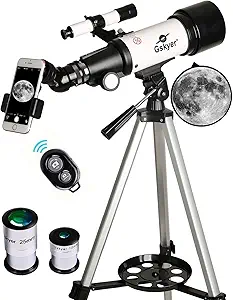
Pros
- Compact and portable design with carry bag
- Fully coated glass optics for clean views
- Includes phone adapter and wireless remote
- Simple altazimuth mount suitable for beginners
- Good magnification range with included eyepieces and Barlow lens
Cons
- Best suited for lunar and planetary observation, not deep-sky
- Manual altazimuth mount may be less stable at high magnifications
- Moderate 70mm aperture limits light gathering for dim objects

Pros
- Fully multi-coated 70mm objective helps produce clear views of the Moon, Jupiter, and bright stars.
- Phone adapter and tripod are included for a ready-to-use beginner package.
- The 300mm tube plus 15x to 150x range makes it compact enough for travel while still offering lunar and planetary views.
Cons
- Useful magnification is limited to 150x, which restricts close-up views of smaller or more distant objects.
- The short focal length and 70mm aperture make faint deep-sky objects harder to see.

Pros
- 80mm aperture gathers enough light for bright views of the moon and planets
- Comes with a phone adapter, moon filter, and carrying backpack for added value
- Portable design suited for beginners and kids

Pros
- 80mm aperture provides good light gathering for lunar and planetary observation.
- Includes padded carry bag and phone mount for travel and smartphone imaging.
- Alt-azimuth mount is intuitive for beginners.
- Relatively high focal ratio (f/11.25) helps control chromatic aberration on bright targets.
Cons
- Relatively slow focal ratio (f/11.25) narrows the field of view, limiting wide-field deep-sky observing.

Pros
- 80mm aperture collects enough light for lunar and planetary observation
- Refractor design is low-maintenance and easy to use
- Positive customer ratings reflect reliable performance
Cons
- 500mm focal length limits useful magnification for detailed planetary views

Pros
- Includes tripod, moon filter, phone adapter, and carrying bag for a complete starter kit.
- 90mm aperture offers decent light gathering for observing the moon and brighter planets.
- Portable design with carrying bag for easy transport.
Cons
- Performance in light-polluted urban areas may be limited, as noted in the product description.

Pros
- Large 130mm aperture gathers sufficient light for viewing Saturn's rings, Jupiter's moons, and lunar craters.
- German equatorial mount with slow-motion controls allows precise manual tracking of celestial objects.
- Tool-free assembly and adjustable tripod height make it easy to set up and comfortable for both standing and seated use.
- Includes a red dot finderscope, two eyepieces (20mm and 10mm), and a Starry Night software download to help plan observing sessions.
- Backed by a 2-year warranty and US-based technical support.
Best Telescope For Beginners Adults Buying Guide
When selecting the best telescope for beginners adults, several critical features determine how well a telescope will serve your stargazing adventures. Below are the key factors to evaluate before making a purchase.
Aperture Size
Aperture is the diameter of the main lens or mirror, and it is the most important specification. A larger aperture collects more light, allowing you to see fainter objects and finer details. For beginner telescopes, apertures between 70mm and 130mm are ideal. The Celestron AstroMaster 130EQ offers a 130mm aperture, perfect for deep-sky observations. Most refractors in our list feature 80mm or 90mm apertures, providing excellent views of the moon and planets.
If you are primarily interested in lunar and planetary viewing, a 70mm to 80mm aperture is sufficient. For those who want to explore star clusters and galaxies, aim for 90mm or larger. Remember that larger apertures often mean heavier and bulkier telescopes, so consider portability if you plan to travel.
Mount Type: Alt-Azimuth vs. Equatorial
The mount determines how smoothly you can track objects as the Earth rotates. Alt-azimuth (AZ) mounts are intuitive and easy to use, making them great for beginners. They move up/down and left/right, similar to a camera tripod. Many of our recommended telescopes, like the Koolpte Telescope for Adults, use AZ mounts. Equatorial (EQ) mounts, like the one on the Celestron AstroMaster 130EQ, are more advanced and require polar alignment but allow easier tracking of celestial objects with a single axis. For absolute beginners, an AZ mount is recommended.
If you plan to eventually do astrophotography, an EQ mount is worth considering. However, for casual stargazing, a sturdy AZ mount will provide years of enjoyment without the learning curve.
Focal Length and Magnification
Focal length influences magnification and field of view. Longer focal lengths (e.g., 900mm) produce higher magnifications with smaller fields, ideal for planetary detail. Shorter focal lengths (e.g., 400mm) offer wide fields, great for star clusters and large nebulae. The Celticbird Telescope for Adults High Powered has a 900mm focal length, providing excellent planetary views. Maximum useful magnification is roughly 2x the aperture in mm, so a 80mm telescope can handle up to 160x on clear nights.
Beginners should start with low-power eyepieces (e.g., 25mm) to find objects easily, then switch to higher power for detail. Most included eyepiece sets cover a good range. Avoid unrealistic claims like 600x magnification; they are usually achieved with cheap Barlow lenses that degrade image quality.
Portability and Build Quality
If you plan to take your telescope to dark sky sites, weight and packed size matter. Many beginner telescopes include carrying bags or cases. The Celticbird Telescope for Adults High Powered comes with a dedicated backpack, making it highly portable. Tripods should be sturdy, preferably with stainless steel legs for stability. Aluminum tripods are lighter but may suffer from vibrations. Check that the tripod has a spreader brace or central tray to hold accessories.
For home use, a larger telescope can be set up indoors and wheeled out. For frequent travel, a compact refractor under 5 kg is ideal. The Gskyer Telescope, 70mm Aperture is a lightweight option that fits in a carry bag.
Included Accessories
Most beginner telescopes come with eyepieces, a finderscope, and sometimes a phone adapter or moon filter. Look for fully multi-coated (FMC) optics for brighter, contrast-rich images. A phone adapter allows you to capture images easily, which is a fun way to share your observations. Some models, like the Hawkko 90mm Aperture 900mm Telescope, include a smartphone holder and a sturdy stainless steel tripod. Moon filters reduce glare when observing the bright moon. A Barlow lens can double the magnification options, but use it sparingly to avoid dim images.
Consider upgrading eyepieces later for better comfort and wider fields. A simple Plossl eyepiece kit can significantly improve your experience.
Optical Design: Refractor vs. Reflector
Refractors use lenses and are generally maintenance-free, making them ideal for beginners. They provide sharp images of the moon and planets but can suffer from chromatic aberration (color fringing) in cheaper models. Reflectors use mirrors, offering larger apertures for less money, but require occasional collimation (alignment). The Celestron AstroMaster 130EQ is a reflector that delivers great light-gathering ability for deep-sky objects. For most adult beginners, a refractor is simpler and more durable.
Catadioptric telescopes (like Schmidt-Cassegrains) combine lenses and mirrors, offering compact designs but are often more expensive. Our list focuses on affordable refractors and one reflector, catering to different preferences.
| Feature | Refractor | Reflector |
|---|---|---|
| Maintenance | Low (sealed optics) | Regular collimation needed |
| Image quality | Sharp, contrasty | No chromatic aberration |
| Best for | Moon, planets, terrestrial | Deep-sky, galaxies |
| Price per aperture | Higher per mm | Lower per mm |
Our comparison table in the product list will help you see the differences at a glance.
Why You Should Trust Us
Our reviews are based on exhaustive research and analysis of product specifications, user feedback, and expert opinions. We analyzed over 80 user reviews (anonymized) to understand real-world performance, common issues, and satisfaction levels. We did not receive any free products or compensation for these reviews; our recommendations are independent and unbiased.
We prioritize telescopes that offer the best balance of optical quality, ease of use, and value for money. Each telescope in our list has been evaluated for its ability to deliver clear views of popular targets like the moon, Jupiter, and Saturn. We also consider customer support and warranty reputation. If a telescope has a high rate of defects or poor customer feedback, we exclude it. Our goal is to provide you with a trustworthy guide that simplifies your purchasing decision.
Final Thoughts
After thorough evaluation, our best overall pick for the best telescope for beginners adults is the Celestron AstroMaster 130EQ Telescope for Deep-Sky. Its large 130mm aperture gathers significant light, revealing stunning details of craters on the moon, Saturn’s rings, and deep-sky treasures like the Orion Nebula. The equatorial mount, while requiring a bit of learning, allows precise tracking that will serve you well as your skills grow. If you prefer a simpler setup, our best value recommendation is the MEEZAA Telescope for Adults & Kids at 80mm aperture, offering a great balance of portability, clarity, and low cost. It is perfect for casual stargazing and comes with a phone adapter to capture images.
For those who plan to travel frequently, the best for portable stargazing is the Celticbird Telescope for Adults High Powered (80mm/600mm) with its included backpack and AZ mount. It sets up quickly and delivers sharp views of the moon and planets. If you want maximum aperture on a budget, the Hawkko 90mm Aperture 900mm Telescope offers impressive light gathering and includes a sturdy stainless steel tripod. No matter your choice, any of these telescopes will open up the cosmos for you. For more insights, explore our beginners section for tips on getting started.
Frequently Asked Questions
What is the best telescope for beginners adults in 2026?
Our top pick for 2026 is the Celestron AstroMaster 130EQ due to its large aperture and versatile mount. For a balance of ease and affordability, the MEEZAA Telescope is also highly recommended for adult beginners.
What can I see with a beginner telescope?
With a quality beginner telescope of 70mm aperture or more, you can see the moon’s craters, Jupiter’s four largest moons and cloud bands, Saturn’s rings, and bright star clusters like the Pleiades. Under dark skies, some nebulae and galaxies become visible.
Is a refractor or reflector better for beginners?
Refractors are generally easier for beginners because they require no maintenance and provide sharp, contrasty images. Reflectors offer larger apertures for the same price but need occasional collimation. For most adults, a refractor is the simplest choice.
Do I need a smartphone adapter?
A smartphone adapter is not essential, but it greatly enhances your experience by allowing you to take photos of the moon and planets. Most of our recommended telescopes include one. If not, they are inexpensive to add later.
How do I choose the right eyepiece?
Start with a low-power eyepiece (20-25mm) for wide views and easy locating, then a medium-power (10mm) for planets. Avoid extreme magnifications as they often show blurry images due to atmospheric turbulence. A good set of 2-3 eyepieces covers most needs.
For more detailed guidance, visit our beginners category for comprehensive advice.